It’s been three months since I came to Hong Kong to attend my postgraduate study at the Hong Kong Polytechnic University. I took Hong Kong’s rail transit MRT from Tai Wei to Hung Hom as part of my daily routine. Because MRT charges a fee for riding a train that uses the cross-harbor undersea tunnel, I rarely went to Hong Kong Island. Only fourth have I gone to the island in the first three months of my study in the Cantonese speaking city. Unlike Hubei where quiet places can be quite easily found, finding a quiet space to get relaxed and calmed down in Hong Kong’s crowded neighborhoods and streets is not easy with rare exceptions for the city’s beautiful countryside parks and remote islands.
Accommodation in Hong Kong is quiet expensive for me, according to Hubei standards, so I rented a bunk bed with a broken bed-board, which caused my quiet a lot of troublesome issues later on and it cost me 3600 HKD a month. The electricity and water charges were also very expensive because I had to pay a rent deposit. My own small writing table was outside in the small living room that measured around 4 to 5 square meters in size and the writing table inside the bedroom belongs to my roommate who owned the top bunk. My roommate swiped on TikTok’s Chinese version, Douyin, and played games with the sound out until around 11:30pm, so I had to go to the university library until 11:00pm to do my homework. In the quiet area of the school library, there were occasional conversations that occasionally seemed to be endless; maybe, this cosmopolitan of around 7 million multicultural residents seemed to be bustling with endless energy and always in high spirits. Seeing the bright green trees outside the window, I reminisced about the seemingly chronic grayish skies of Qianjiang in Hubei, and although it remained an remote city unknown to many people outside, at least I had a room of my own, and was able to take a break and stay quietly alone for a while.
On the subway in Hong Kong, if you are not in a quiet zone, it’s very possible that there is going to be people talking energetically and making a lot of laughters. Yesterday evening, when I was walking from the footbridge of the Hong Kong Polytechnic University to the subway station of Hung Hom, I heard sharp laughters; it seemed to be some female students talking about certain teenage issues. However, I found it hard to get a resting place in the pale lit subway station where people kept coming in and going away. In an interview with the Paris Review (Gobeil, 1965), Beauvoir confessed that she herself was not a good teacher, as a good teacher needs to be attentive to the needs of all students (good and bad), but she confessed that she was only interested in the good ones:
“because I was interested only in the bright students and not at all in the others, whereas a good teacher should be interested in everyone. But if you teach philosophy you can’t help it. There were always four or five students who did all the talking, and the others didn’t care to do anything. I didn’t bother about them very much.”
Like Simone Weil, Beauvoir had once been a philosophy teacher for a while, and it seems that the only practical career path for people in the world of literature today is to become a teacher. Sontag once said that literature is an education for the soul, to let people realize the possibilities of their life and understand what is right, good and evil. However, in today’s world, which seemed like a wilderness, all that seemed to grow out of the ground is high-rise concrete buildings, and people are extremely concerned with money and profit-making. Whenever I returned to my tiny rented apartment, the female guard in the hall always greeted me with smiles, and I was touched and smiled back, saying thank you to her. At that time, I felt a sense of comfort and respect when I was particularly tired. In Qianjiang, these small courtesies have gradually been forgotten, there is more indifference in people’s faces. One day on the streets of Tai Wei, New Territories, when I arrived at the elevator exit under a footbridge, a delivery man on a bicycle suddenly appeared at the entrance, wearing a helmet and in his mid-fifties, nearly hitting me in the front, he said sorry in with a Cantonese tone, sounding like soli or so; he was a typical thin-figured Hongkonger. “I didn’t at that time get his word so it’s a pity that I didn’t respond to him with a “doesn’t matter”. Hong Kong is a place where many small acts of kindness happen, and that’s what I want to preserve.
While lining up before the checking stop to enter Hong Kong, I found my cellular carrier had halted service because I hadn’t applied roaming service before entering the city. But as my friend Mr. Hsu, who resides in Shenzhen and travels to Hong Kong frequently, already passed border through fast-checking service, unable to contact him, amid a sea of black heads, I felt lost at the beginning of the journey. Where was I going?
Waiting lines at the border check snaked about twenty meters long. A checker handed back me my visa on which he stamped. People around me didn’t say none as if all of them knew it would only be a matter of time before they reached their destinations.
What if Mr.Hsu decided to leave me alone after finding out he was unable to contact me. I felt regretful for causing troubles to him for this. Amid a sea of people in the narrow corridor at Hong Kong side, I found Mr. Hsu leaning against a railing waving his hands towards me. ‘It was lucky.’ He said.
I thanked him and expressed my regret for causing inconveniences. He smiled and said to me that was fine.
Getting off the bus at downtown Kowloon, I found so narrow were the sidewalks that carrying a luggage up-and-downs to and fro the metro stations was like doing performing arts in an open air theatre lest I be seen as a clumsily behaved tenderfoot.
Arriving at the hotel room we ordered was at afternoon.The hotel itself where we stayed was sophisticated, located at the Island. Looking through the mists over the Victoria strait, I saw glistening skyscrapers tinted darkening-yellow glowing sharply.
Near where we stayed was a freight wharf, empty and around which pedestrians strolled idly. The wharf itself, where a vessel docked must be busy usually. Because the prosperous docks of Hong Kong were vividly recorded by old-fashioned music videos, it now seemed a bit sentimental to look at Hong Kong’s nearly deserted wharfs.
Before this, I had never been to Hong Kong but had imagined what it would look like to live there; maybe, like other cities that underwent painful world wars, uneasy histories might have made the city’s humanitarian heritages even diverse.
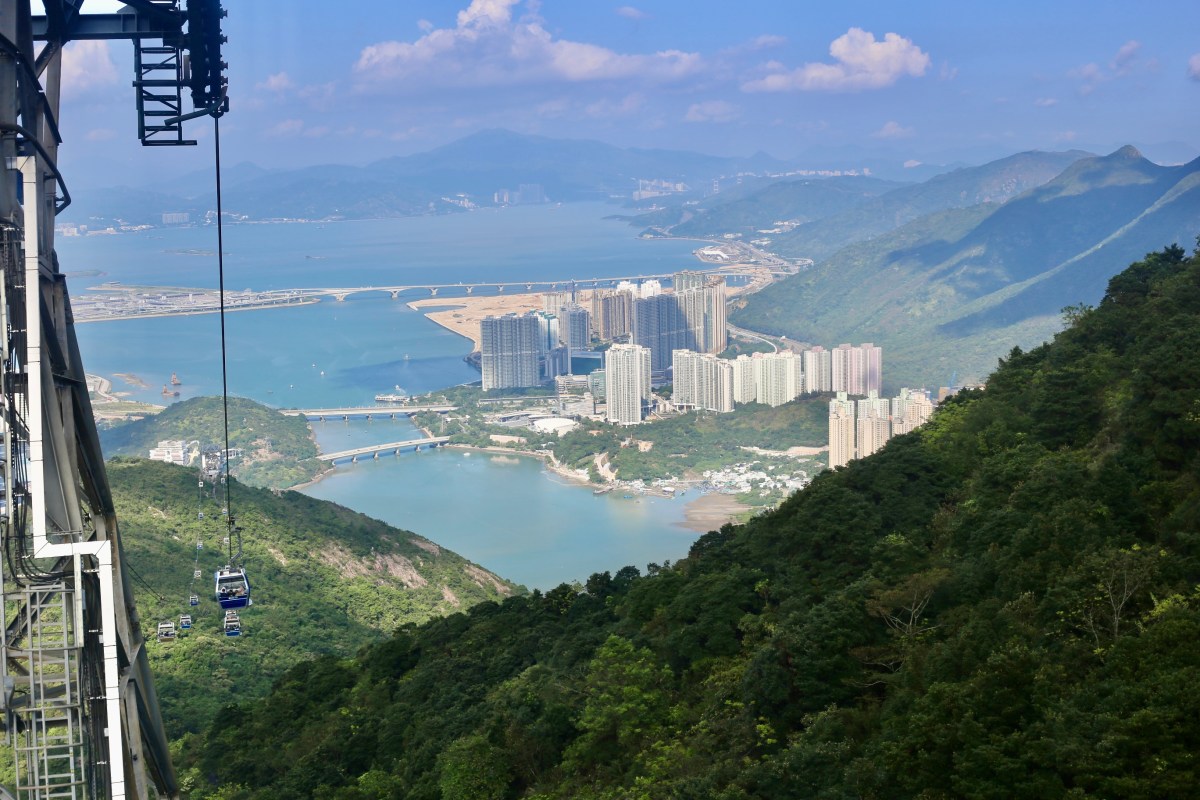
Mr.Hsu suggested us to go to remote island areas where Tian-Tan Buddha is located. By bus, we were on the way to crossing mountains; with several speeding-up and descending patterns, so scary was to ride a bus whose driving route comprised spiral mountain paths that seemingly endless u-turns made me worry about how concentrated the driver was, whether we’d be safe or how many cups of coffee might be required for the driver lest he be distracted or sleepy while driving on such dangerous roads like this. I had worried about this, going on a pattern of magical thinking but when I saw Mr.Hsu fallen asleep beside my seat, softly, quietly, my wariness had disappeared. Several months after, while alone, seeing a news reporting that at a narrow steep hill way, Hong Kong, a bus had crashed severely, leaving about 19 to die, never once had I felt so exhausted and painful to recall my own experience of riding the bus then in Hong Kong. Before then, no matter how swingingly or fast the driver drove the bus, we thought that would be fine only to find out that we were much luckier than thought just because we were fine. Fine.
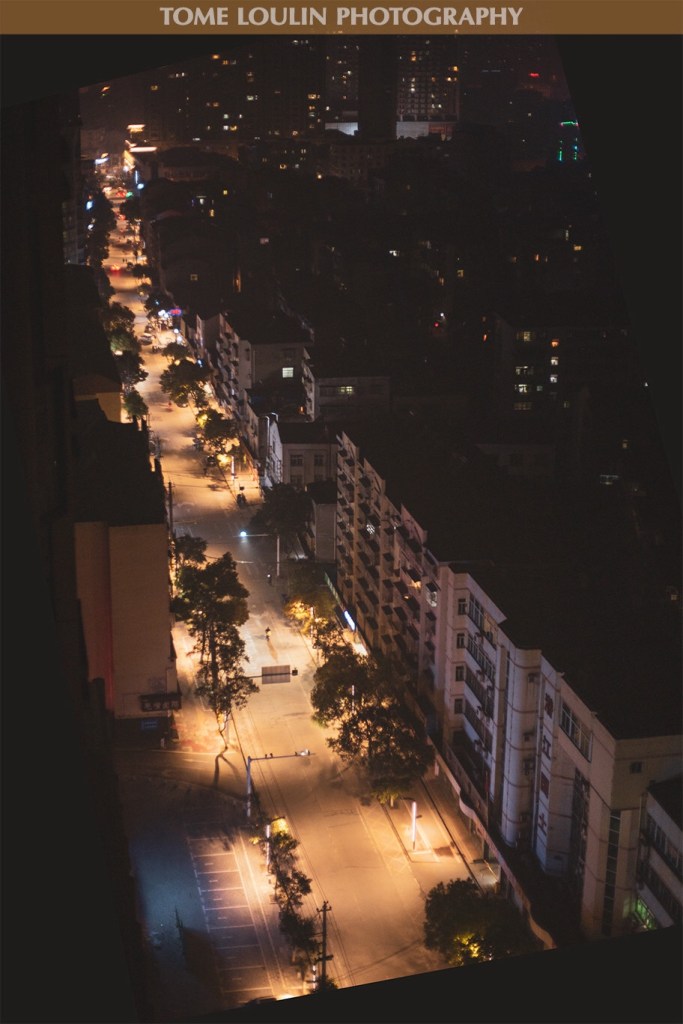
Night view of a small city in Hubei province, by Tome Loulin.
The terminal stop of this ride was at a seashore ville. The boats bobbing on the sea were moored to the wooden piers, seemingly newly-built and refreshing under the meek afternoon light. Most villagers here worked as fishermen, some chefs
With subtropical featured buildings, walking in the narrow alleys in the village was like immersing oneself into Mediterranean paintings. There were seafoods, dried, canned, plasticized, and through which flies winged up-and-downs, placed on the selling tables sold almost everywhere I went.
Serving curious tourists who regarded their lives as objects to be observed must have tired them, especially on a daily basis.
Muddy trails at the back of the village, at mountain-foot and with well-kept trees, were well-preserved. Some metal or wood-built shacks seemed fully occupied and were aesthetic in some ways because of their vividly painted walls. Hearing Cantonese spoken all around by senior citizens, emotionless when facing tourists without giving a look, Mr.Hsu and I were the only couple speaking Mandarin here but not felt lonely.
Mr. Hsu wondered whether I was hungry because we almost hadn’t eaten any except some egg tarts, and bakeries after morning breakfast and it was quite late afternoon. So we had entered a family-owned café, dimly lit and whose owners talked busily as if not caring much about whether there were patrons coming or not. That’s understandable regarding their seniority. Serving curious tourists who regarded their lives as objects to be observed must have tired them, especially on a daily basis.
In a report published on a local newspaper, a teenage girl living in a poor fishing village in Hong Kong giving up her college education told the reporter that her family was under economic strain so she had to quit school after graduating from high school to go working, to earn money to support her younger siblings. ‘Well, I thought that’s what I should start to shoulder.’She said.
It was still too soon for a teen-ager to decided what a future he or she wants if not properly informed. Some may make myopic decision while others unable to realize how important education was that if the time to study passed, the damage caused by the loss of access to education, could be irreversible.
When I walked alone in the university of Hong Kong, a young women referencing maps and a Cantonese guide approached and inquired me about a place which I didn’t know. ‘Hi-bien-do?’ She asked.
I said to her I was a visitor so I cannot help. At HKU’s museum of art was a N.K propaganda exhibition being held. Uninterested in those, I went to the souvenir stall and bought a card cover and left.
On the bus from Tai-ping peak, passing a public cemetery, Mr. Hsu said while in Germany, he found the hotel he and his friend stayed was near a cemetery, concluding that foreigners weren’t feeling what we might feel when being near a cemetery. Maybe that’s because of the influence of Christianity.
When pasting an post to rent her apartment on a bulletin board beside me, casually voiced, a house owner about in her middle sixties said to me, that as her apartment was near the funeral home, she planned to lay a slide linking the window of her house to the home to let her slide down directly to the yard of the home once her time comes.
While I sat on a couch in the hotel lobby reorganizing my suitcase, a hotel manager approaching me, whose back slightly bowed, complimented me on my suitcase and inquired where I was from. I thanked him and answered him that I was from mainland China. Seeing him being in a state of contemplation, I felt regretful of not answering him more precisely when he seemed to expect an answer much more precise than mainland China. I hope he could forgive my uneasiness of answering such questions.
Where I am from? When I was little, being asked about such questions, I answered with my hometown. Some knowingly smiled; some confused. It occurred to me then that as one grows the frequency of being asked about such questions grows too. Not everyone who asks such questions truly wants to know the answer. While in Beijing, encountering a man chicaning on insisting me to look at his superb new iPhone, not knowing that person’s intention and uninterested, I said to him to stop follow me. Contemptuously voiced, he shouted out that art thou from Hubei?
For a while knowing both how useless that people explain to those who deliberate to insult them was and how powerless words could seem while defending one’s stance, I ignored him.
‘Don’t ask me where I come from, ask where I belong.’ An podcaster said. I found by and by, it was to me harder and harder to answer such a question. ‘To answer that question, people need to have a place they could feel and call home.’ I read that line from a newspaper.
There were still newspaper stalls on sidewalks. For in recent decades I witnessed printed-publishings dying off in mainland China because of the declining of the readership in print media, it’s a bit nostalgic to see this used to be taking-for-granted scene reappear but once again our world had proved nothing is truly granted to be here forever. Without newspaper stalls, our past time may be dissolved altogether from our imagination. So I bought a local published English newspaper from an old lady sitting on a stool overseeing her newspapers for sale. That was late morning. Then, I had a new day half-passed but another half-full left here for me to go on.
On the way back to Shenzhen, almost every passager setting on the bus seat fell asleep except me and Mr. Hsu who sat on the opposite seat facing me. I knew the reason I didn’t take a nap then was that the time remained for me to spend on both seeing Hong Kong a bit longer and being with Hsu was diminishing, by and by, to nearly zero. A young man fallen asleep with his hands swaying unknowingly seemed so tired that he must have toiled all day. Hongkongers must have worked very hard. ‘Applying bankruptcy protection now so debt-collecting will be halted.’ an advertisement painted on a building read. ‘Are they happy?’ I’d thought for a moment. Just then, meeting Mr.Hsu’s eyesights, I smiled to him and he returned that smile to me softly. There was a meek silence inside the bus; though everyone seemed tired, we did not. Returning to Shenzhen, looking back at Hong Kong at the starless night, ‘where I came from?’ I’d asked myself.
I’d remembered lines from a poem written by Li Bo and translated by Rewi Alley: “We who live on the earth / are but travelers; / the dead like those / who have returned home; / all people are as if / living in some inn, / in the end each and every on / going to the same place.”

You must be logged in to post a comment.